
Why multimodal communication is so important at big events
If you’ve ever been to a big, crowded event, you will have seen support crews calling in jobs on event radio networks. Radio is typically the lifeblood of large events and the primary communication channel between ground staff and the control room.
But what happens when circumstances conspire to make communication on event radio networks impossible? How can event organisers continue to deliver their duty of care to patrons when they can’t communicate with each other?
This scenario is not as unlikely or as far-fetched as it sounds. In fact, just last year, at one of Chronosoft engagements for a large music production, the event radio network became saturated and threatened to disrupt the smooth, safe running of the event.
Fortunately, organisers had included Chonosoft multimodal communication capabilities in their planning and when the problem arose, they knew exactly how to react.
So how did the event radio network become saturated in the first place?
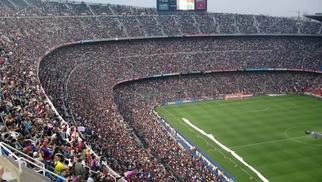
The concert attracted an older audience than your average music production. And when 60,000 fans, many of whom were advanced in years, converged on the stadium, the security and safety teams were inundated with requests for wheelchairs and other access assistance.
The radio network became saturated with low priority traffic which threatened to delay high priority communication and could have disrupted the smooth entry of patrons into the stadium.
Thankfully, due to great planning and the multiple modes of communication offered within the Chronicler system, organisers instantly offloaded these lower priority / routine jobs to other channels like SMS and the ChonoLink app.
This cleared the airwaves leaving direct radio communication between ground staff and the control room free to coordinate the response to any higher priority incidents that occurred.